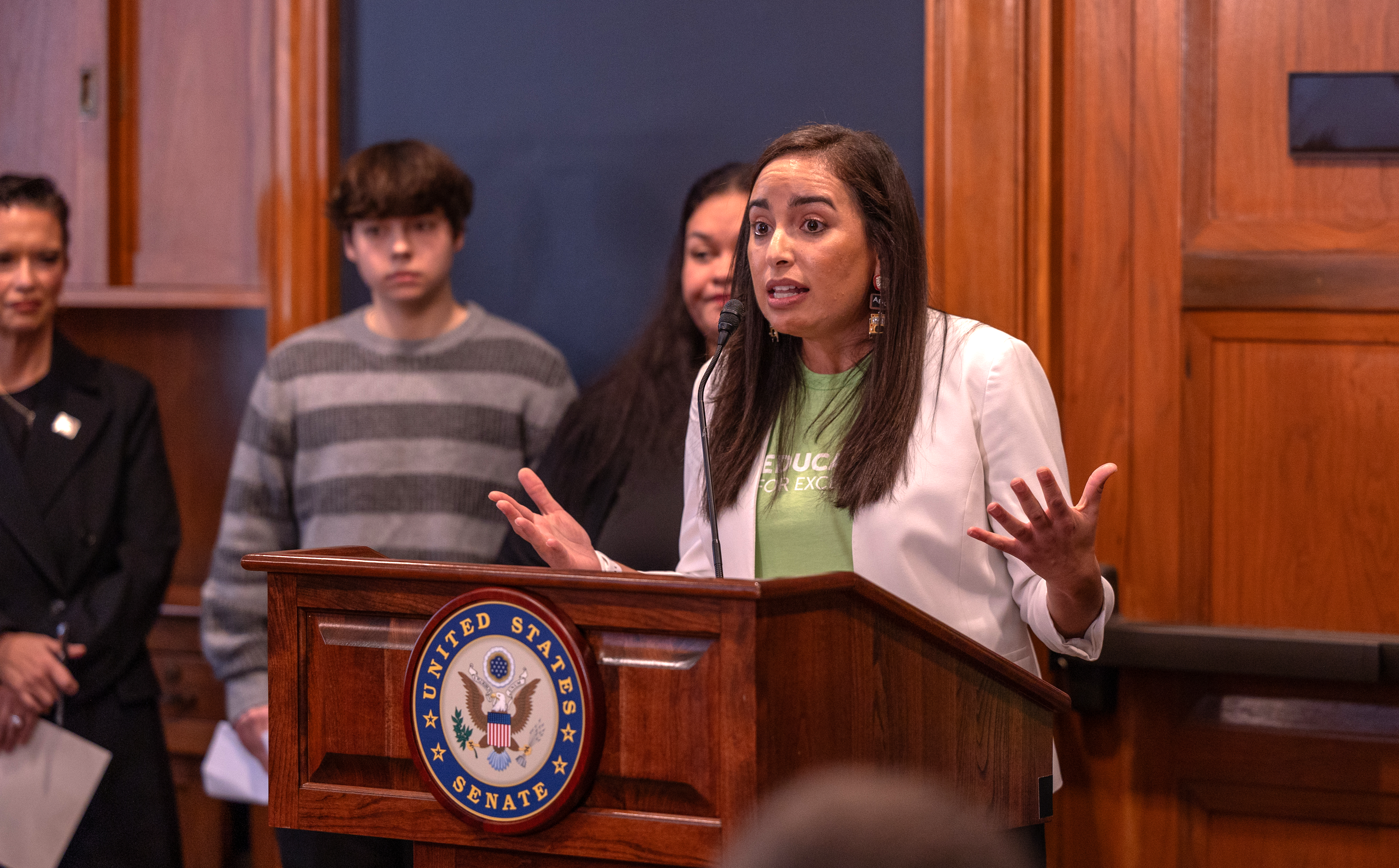
At Educators for Excellence (E4E), we know that uncertainty and anxiety are running high in schools. We created this page to give you easy access to the latest information and resources that will help you separate fact from fiction, understand what the headlines mean for your school, and take action to keep yourself and your students safe, supported, and ready to learn.
Federal Education Action Updates
The Latest: In September, the House introduced a budget that would cut federal education spending by 15%, including billions from Title I. The House and Senate must now reconcile their versions of the bill.

Federal Funding
On September 2, the House introduced a budget that would cut federal education spending by 15%.
The federal government plays a critical role in education funding. The current administration has attempted to dial back much of its role in doing so. Here is a brief timeline of actions taken thus far:
In March, Secretary McMahon abruptly revoked extensions previously granted to states to spend COVID-19 federal relief money, making the $2.5 billion districts had already committed to projects unspendable. Sixteen states successfully sued.
In April, the administration terminated a billion dollars of already approved grant funding for hiring school-based mental health staff. Sixteen states have sued.
In July, USED notified districts that it would illegally withhold seven billion dollars for English learners, professional development, and more. A coalition of states sued. The administration released the money at the end of July, but not before it disrupted the work of districts nationwide.
In May, President Trump released his proposal for federal funding in the coming fiscal year. He proposed slashing $12 billion in education funding, 15% of the budget. The Senate advanced a bipartisan education budget bill rejecting these cuts, but the House proposed a version in line with President Trump’s proposal. The Senate and House must now reconcile their versions of the budget.
In late August, the Trump administration once again cancelled or delayed billions of dollars in already approved federal education grants, including for teacher training programs and desegregation, with no notice.
Learn More

U.S. Department of Education
On July 14, the Supreme Court ruled that the Trump administration could proceed with mass firings at the USDE.
Learn More

The “Big, Beautiful Bill” (OBBB)
On July 4, Trump signed OBBB into law, cutting SNAP and Medicaid and creating a federal private school voucher program.
Congressional Republicans passed a bill in July that will devastate America’s public school students, and did so in a way that ensures as little public awareness and input as possible. The bill (1) puts millions of children’s SNAP benefits and access to free school meals at risk, (2) cuts Medicaid funding for millions of students, depriving them of health care and school-based health services, and (3) creates a federal voucher program that would use billions of dollars to fund private school tuition and tax breaks for wealthy families. Most of the bill’s provisions will not go into effect until after the 2026 midterm elections.
Learn More

Immigration & English Learners
In September, a judge blocked the Trump Administration’s ban on undocumented students attending Head Start.
In January, the Trump administration revoked a policy that barred Immigration and Customs Enforcement (ICE) agents from schools, but ICE still needs a warrant to access schools. Every child deserves a safe learning environment; revoking the ban has sowed confusion and fear.
In June, the administration ramped up ICE immigration raids in California, which both teacher reports and research indicate contribute to heightened student absenteeism for fear of deportation.
In July, the administration announced undocumented children would no longer be able to attend Head Start. Twenty-one states quickly sued and in September, a judge blocked the policy.
In August, the administration rescinded guidance directing schools to ensure the nation’s 5 million English learners, many born in the U.S., could participate meaningfully in a high-quality education. While not legally binding, the guidance provided crucial direction for serving these students.
Learn More

Race-based Programming
In August, a judge ruled that Trump’s guidance on race and education decision-making is illegal and must be reversed.
In January, President Trump called on federal agencies to create a plan to withhold funds from schools that teach the U.S. is “fundamentally racist” or about “gender ideology.” This is an attempt to intimidate and divert schools from implementing culturally relevant curricula and from teaching accurate history. It is illegal for the federal government to try to control curriculum decisions.
In February, the Trump administration issued guidance threatening to cut federal funding for schools that use “race as a factor in … hiring, training, and other … programming.” The letter doesn’t change the law and is meant to intimidate districts into complying. In April, the Administration sent a memo to state leaders requiring them to return a signed letter confirming they have reviewed the guidance and that they understand they risk losing federal funding if they don’t comply.
Multiple federal rulings in response to lawsuits—the most recent in August—have struck down the administration’s guidance on this issue, declared it violates the law, and required that it reverse course.
Despite this, in July, the administration released new guidance about how specific DEI programming could violate discrimination laws. The guidance isn’t legally binding and is meant to intimidate schools into complying. The lawsuits described above still stand. Comment end
Learn More

LGBTQ+ Students
In September, the administration threatened to withhold New York City funding over a policy allowing students to use bathrooms aligned to their identity.
In January, the Trump Administration instructed schools to stop enforcing federal rules that prohibited discrimination against LGBTQ+ students. However, in many states, LGBTQ+ students are protected from discrimination by state law.
In February, President Trump called for the elimination of federal funds for schools allowing transgender students to use facilities, play on sports teams, or identify using pronouns aligned with their identity. Some states already had laws preventing this, so this new rule does not impact them. However, none of E4E’s chapter states did; those states must now prohibit transgender students from these activities. To eliminate federal funding for a school violating this rule, the administration must identify a violation and find the school refuses to address it.
In April, the USED announced a new “Title IX Special Investigations Team” that will investigate gender ideology in schools, especially participation of transgender athletes on female sports teams.
In September, the Department of Education threatened to withhold millions in federal funding from New York City Public Schools if they do not change their policy that allows students to use the bathroom that aligns with their gender identity. The administration made similar demands of Chicago Public Schools the week prior, but the district has indicated they will refuse to comply.
LGBTQ+ students may be protected under state law depending on where you live, and regardless you are allowed to continue to support and defend your LGBTQ+ students.
Learn More

Research & Innovation
In August, a judge ruled that Trump illegally defunded multiple research programs run by the Institute of Education Sciences.
In February, the Trump administration terminated nearly $900 million of Institute of Education Sciences (IES)-funded research program contracts, including the What Works Clearinghouse, which helps educators translate research into practice, and the Regional Education Laboratories. In many cases, these contracts were nearing completion but now will not be able to conclude or release findings. President Trump also proposed cutting IES’s funding by 67% in his FY26 budget proposal.
The Administration also terminated $600 million of teacher training grants that sought to improve and evaluate teacher preparation, claiming they were “wasting valuable training resources on divisive ideologies.” This action has left districts scrambling to figure out how to pay teacher leaders. This action is legally questionable, as Congress voted to spend the money. Lawsuits have been filed and decided in favor of reinstating the grants, but the Supreme Court overturned one of these decisions in April. Trump also proposed eliminating these grants in his FY26 budget proposal.
On February 20, the Administration canceled an upcoming National Assessment of Educational Progress (NAEP) test, the only nationwide measure of student achievement. It later gutted the National Center for Education Statistics (NCES)—reducing its staff from 100 employees to three—the office that administers NAEP.
In August, a federal judge ruled that some of the Department’s cuts, specifically those made to the Regional Education Laboratories, were illegal.
Learn More
Take Action
Tell the Secretary of Education: Do Your Job!
Contact your federal lawmakers and urge them to protect the U.S. Department of Education and demand that Secretary McMahon do her job!
Press Releases & Statements
November 18, 2025 – “Today’s announcement—that the U.S. Department of Education will further downsize and disperse key agency offices across other federal agencies—is the clearest example yet of this administration’s short-sighted disregard for the more than 50 million K–12 public school students who rely on a functioning federal backstop.”
Read the Full Statement | Previous Statements